Steel Pipe vs Patra Pipe Manufacturer: Key Differences & Comparison
A complete guide to help you choose the right pipe type for your project
Introduction
When sourcing steel products for construction, fabrication, or infrastructure projects, buyers often face a common question: should I buy from a steel pipe manufacturer or a patra pipe manufacturer? While both produce tubular steel products, the differences in manufacturing process, quality standards, dimensional accuracy, and end-use applications are significant.
This blog provides a detailed comparison between steel pipes (ERW pipes) and patra pipes, helping buyers, contractors, and procurement teams make informed sourcing decisions based on their project requirements.
What Are Steel Pipes (ERW Pipes)?
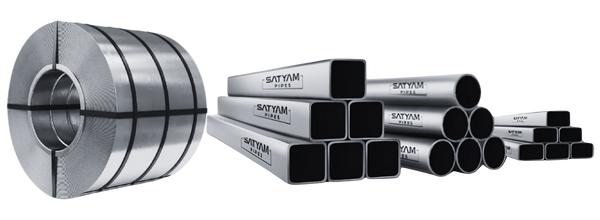
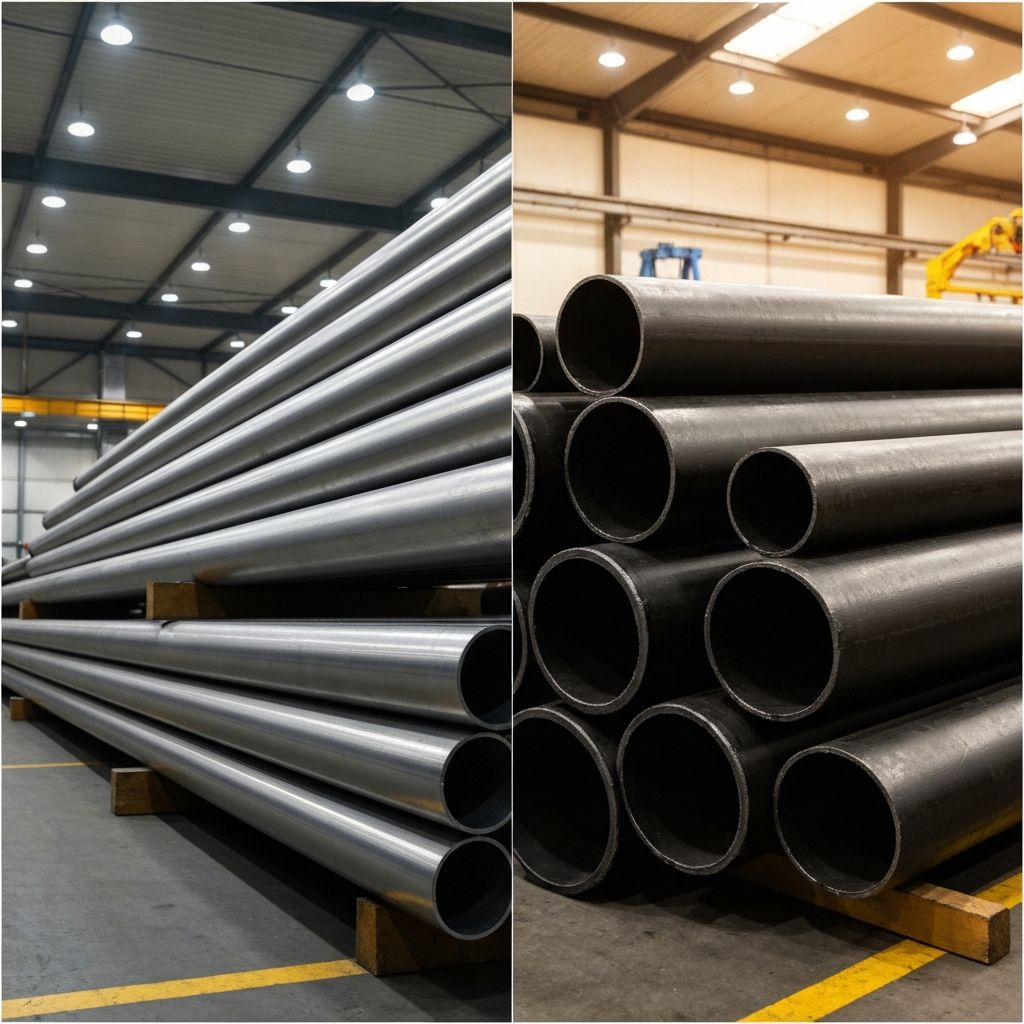
Steel pipes, particularly ERW (Electric Resistance Welded) pipes, are manufactured using advanced welding technology where steel strips or coils are formed into tubular shapes and welded using high-frequency electric current. These pipes are produced under strict quality controls and meet national and international standards such as IS 1239, IS 3589, IS 4923, and ASTM A500.
ERW steel pipes are available in:
- Round, square, and rectangular cross-sections
- Galvanized (GI) and black (ungalvanized) finishes
- Precise wall thicknesses and outer diameters
- Standard lengths of 6 meters or custom sizes
What Are Patra Pipes?
Patra pipes are mild steel (MS) pipes manufactured from steel sheets or HR coils using conventional forming and welding methods. These pipes are produced with commercial-grade tolerances and are primarily used in applications where structural strength and affordability matter more than dimensional precision.
Patra pipes are typically available in:
- Round and square sections
- Black (uncoated) finish
- Standard commercial grades
- Various diameters and wall thicknesses
Manufacturing Process Comparison
Steel Pipe (ERW) Manufacturing
The ERW pipe manufacturing process involves several precision-controlled stages:
- HR Coil Selection: Premium-grade hot rolled coils are sourced and tested for chemical and mechanical properties.
- Coil Slitting: Coils are precision-slit into strips matching the required pipe specifications.
- Forming: Strips pass through multiple forming rollers to achieve the exact tubular shape.
- Electric Resistance Welding: High-frequency electric current welds the edges without filler material, creating a clean and strong seam.
- Weld Seam Treatment: The external weld bead is removed (scarfed) for a smooth surface finish.
- Sizing & Straightening: Pipes are calibrated through sizing rollers for precise dimensions.
- NDT Testing: Non-destructive testing (ultrasonic/eddy current) ensures weld integrity.
- Cutting & Marking: Pipes are cut to length and marked with specifications.
Patra Pipe Manufacturing
The patra pipe manufacturing process is comparatively simpler:
- Steel Sheet/Coil Procurement: MS sheets or HR coils are sourced based on commercial grade requirements.
- Slitting: Coils are slit into strips of required widths.
- Forming: Strips are formed into tubular shapes using roll forming.
- Welding: Conventional welding or basic ERW methods are used to join the edges.
- Sizing: Basic sizing to achieve approximate dimensions.
- Cutting: Pipes are cut to standard or custom lengths.
- Visual Inspection: Basic quality checks before dispatch.
Detailed Comparison: Steel Pipe vs Patra Pipe
| Parameter | Steel Pipe (ERW) | Patra Pipe |
|---|---|---|
| Manufacturing Method | Electric Resistance Welding | Conventional forming & welding |
| Dimensional Accuracy | High (tight tolerances) | Moderate (commercial tolerance) |
| Quality Standards | IS 1239 / IS 4923 / ASTM | Commercial grade |
| Weld Quality | NDT tested, scarfed | Visual inspection only |
| Surface Finish | Smooth, uniform | Rough, basic |
| Cost | Higher | Lower |
| Wall Thickness Consistency | Uniform throughout | May vary |
| Corrosion Resistance | Available in GI finish | Typically black (uncoated) |
| Primary Applications | Plumbing, water supply, gas lines, precision engineering | Scaffolding, fabrication, fencing, furniture |
| Availability | Through certified manufacturers | Widely available in local markets |
When to Choose Steel Pipes (ERW)
ERW steel pipes are the preferred choice when your project requires:
- High dimensional accuracy for precise fitment
- Compliance with IS/ASTM standards for government or institutional projects
- Water supply, plumbing, or gas line applications where leak-proof joints are essential
- Long-term structural integrity in bridges, buildings, and heavy engineering
- Galvanized (GI) coating for outdoor or corrosion-prone environments
When to Choose Patra Pipes
Patra pipes are a practical choice when:
- Budget is a primary constraint and commercial grade is acceptable
- Temporary structures like scaffolding or construction supports are needed
- Fabrication work like metal frames, sheds, or racks requires quick availability
- Agriculture applications like fencing or greenhouse frames where precision is not critical
- Furniture manufacturing for beds, tables, and utility products
Quality Parameters to Evaluate
Whether you are sourcing from a steel pipe manufacturer or a patra pipe manufacturer, always evaluate these quality parameters:
- Wall thickness consistency: Measured using ultrasonic thickness gauges
- Weld seam strength: Tested through flattening and hydrostatic tests for ERW pipes
- Surface finish: Smooth surface indicates better manufacturing control
- Straightness: Pipes should be free from bends and warps
- Certification: Look for BIS certification for ERW pipes and mill test certificates for all products
Industry Applications Breakdown
Construction & Real Estate
Steel pipes (ERW): Used in structural columns, water supply systems, fire-fighting installations, and load-bearing frameworks. Patra pipes: Used in scaffolding, temporary supports, and boundary fencing during construction.
Manufacturing & Engineering
Steel pipes (ERW): Used in machinery frames, automotive components, and precision equipment. Patra pipes: Used in storage racks, workshop structures, and industrial sheds.
Agriculture & Rural Development
Steel pipes (ERW): Used in irrigation systems and water distribution networks. Patra pipes: Used in fencing, greenhouse structures, and equipment supports.
Infrastructure & Government Projects
Steel pipes (ERW): Mandatory in most government infrastructure projects due to BIS certification requirements. Patra pipes: Used in ancillary support structures where commercial grade is acceptable.
Cost Comparison: What Buyers Should Know
The price difference between steel pipes and patra pipes typically ranges from 10% to 30%, depending on specifications and market conditions. While patra pipes offer immediate cost savings, it is important to consider:
- Total cost of ownership: ERW pipes may last longer due to superior quality, reducing replacement costs
- Project compliance: Using non-standard pipes in certified projects can lead to rejection and rework
- Safety considerations: Structural applications demand tested and certified pipes to prevent failures
How Satyam Steel Serves Both Segments
As a leading integrated steel manufacturer, Satyam Iron & Steel Company produces both high-quality ERW steel pipes and patra pipes, catering to diverse market segments:
- ERW Pipes: Available in round, square, and rectangular sections, manufactured under strict quality controls with BIS certification.
- Patra Pipes: Cost-effective mild steel pipes for structural and fabrication applications.
- Raw Materials: HR coils and billets are manufactured in-house, ensuring quality from source.
Conclusion
Both steel pipes and patra pipes serve important roles in the Indian manufacturing and construction ecosystem. The choice between the two should be driven by project specifications, quality requirements, budget constraints, and compliance needs.
For projects demanding precision, certification, and long-term reliability, ERW steel pipes are the right choice. For cost-effective structural and fabrication needs, patra pipes offer practical value. Partnering with a manufacturer like Satyam Steel that produces both ensures consistent quality and supply reliability across all your requirements.
FAQs
Q1. What is the main difference between steel pipes and patra pipes?
Steel pipes (ERW) are manufactured with precision using electric resistance welding and meet strict IS/ASTM standards, while patra pipes are mild steel pipes made from sheets or coils with commercial-grade tolerances, primarily used for structural and fabrication purposes.
Q2. Which is more cost-effective, steel pipes or patra pipes?
Patra pipes are generally more cost-effective than precision steel pipes (ERW). However, the lower cost comes with moderate dimensional accuracy. For applications requiring tight tolerances and higher quality, ERW steel pipes offer better long-term value.
Q3. Can patra pipes be used in place of ERW steel pipes?
It depends on the application. For structural support, fabrication, fencing, and furniture, patra pipes are suitable. For plumbing, water supply, gas lines, and precision engineering, ERW steel pipes are recommended due to their higher quality standards.
Q4. How do I choose between a steel pipe manufacturer and a patra pipe manufacturer?
Consider your project requirements: if you need high precision, certified quality, and compliance with IS/ASTM standards, choose an ERW steel pipe manufacturer. If cost-efficiency and structural strength for general applications are your priority, a reliable patra pipe manufacturer is the right choice.
Q5. Does Satyam Steel manufacture both steel pipes and patra pipes?
Yes, Satyam Iron & Steel Company manufactures a wide range of ERW steel pipes including round, square, and rectangular sections, as well as patra pipes for structural and fabrication applications, ensuring quality across all product lines.
Need Steel Pipes or Patra Pipes?
Contact Satyam Steel for premium quality ERW steel pipes and cost-effective patra pipes, manufactured with consistent quality for every application.