Top Steel Pipe Applications in India's Fastest-Growing Infrastructure Projects (2026 Guide)
From highways and metros to water supply networks and industrial facilities
Introduction: The Infrastructure Boom and Steel Pipe Demand
India's massive infrastructure investments—from highways and railways to water networks and industrial corridors—are significantly boosting demand for durable steel pipes. Government-led initiatives such as the National Infrastructure Pipeline and PM GatiShakti are accelerating construction across roads, bridges, power, and urban facilities. In April 2026, finished steel consumption rose 8.1% year-on-year to 12.99 million tonnes, underscoring booming demand driven by construction and manufacturing. This comprehensive guide explores the top applications of ERW and mild steel pipes in major infrastructure projects, helping buyers understand which pipes to specify for each use.
Highways, Bridges, and Transport Projects
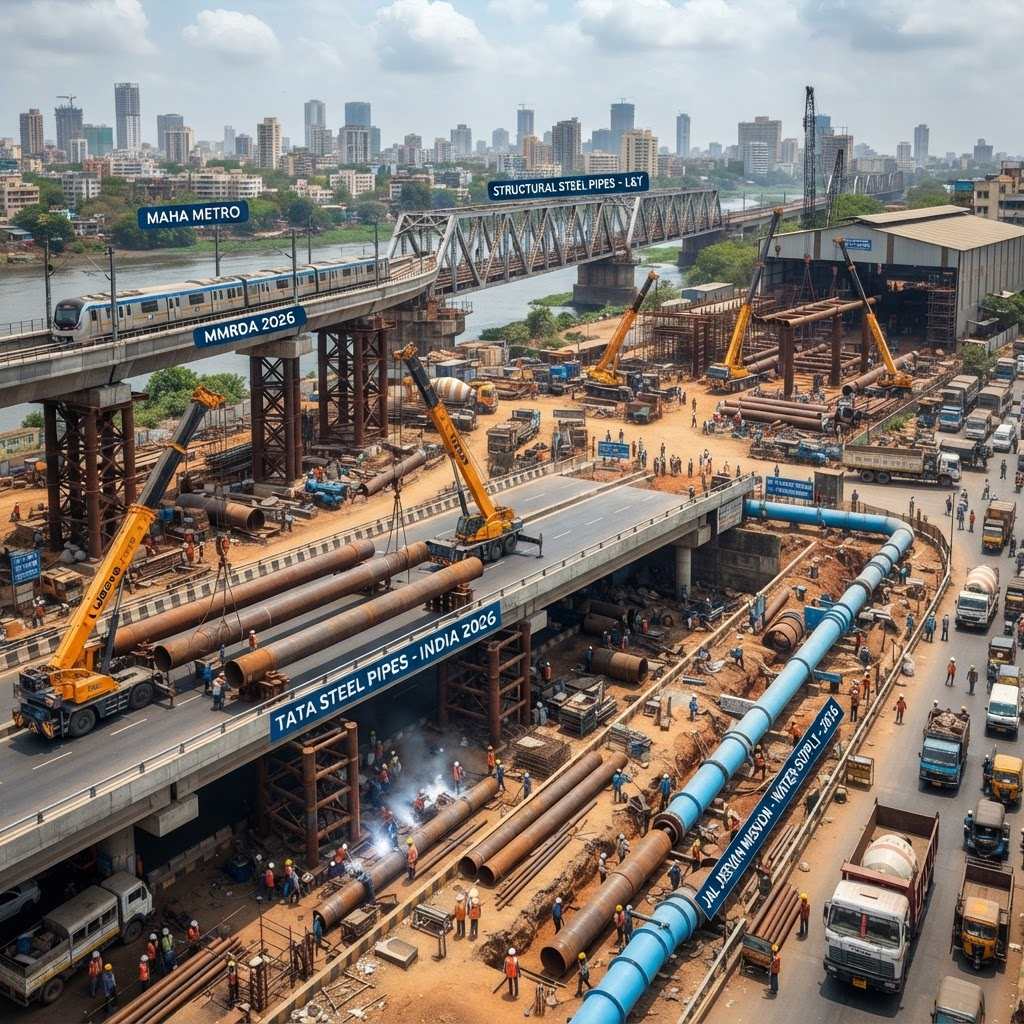
Modern highways, metro lines, and rail bridges are among the largest consumers of steel pipes. Steel pipes form structural supports, safety barriers, and guardrails, and serve in highway drainage and lighting pole supports. India's national highway network has expanded to over 145,000 km, requiring extensive long and structural steel components. Elevated expressways and flyovers often use rectangular and round ERW rectangular pipes and ERW square pipes in their scaffolding and framework due to their high load-bearing capacity. Bullet train and metro projects under the ₹12.2 lakh crore infrastructure budget are driving use of heavy-duty steel pipes in tunnel and viaduct construction. ERW round pipes (CHS) offer excellent torsional resistance for columns and bridge pilings.
Water Supply and Irrigation Systems
Quality steel pipes play a vital role in India's water infrastructure. With the Jal Jeevan Mission extended by ₹67,000 crore in recent funding, demand for dependable water-distribution networks has surged. Mild steel (MS) and ductile iron (DI) pipes are used in trunk mains, pumping stations, and rural water supply to ensure longevity and leak resistance. In cities and industrial areas, galvanised steel (GI) pipes are often used for treated water, while high-strength ERW pipes carry raw water across distances. In farming regions, steel pipes are integral to lift irrigation and canal projects, thanks to their ability to withstand high pressure and harsh environments.
Construction and Industrial Fabrication
Steel pipes are foundational in general construction and industrial facilities. From supporting multi-story building frames to forming columns in manufacturing plants, ERW pipes deliver the strength required for heavy loads. Construction projects frequently rely on black (uncoated) ERW pipes for scaffolding, temporary supports, and plinth construction. Warehouses, factories, and petrochemical plants use thick-walled ERW rectangular pipes to build durable structural frames and overhead conveyors. With India's manufacturing sector on the rise, backed by policies like Make in India and PLI schemes, industrial steel pipe consumption is also growing.
Energy, Power, and Utilities
The power and energy sector is another major consumer of steel pipes. Energy infrastructure projects like power plants, substations, and refineries use extensive networks of steel pipelines for fluid transport, cable conduits, and structural supports. Wind turbine towers and solar plant mounting frames incorporate steel pipes for tall, sturdy structures. As India expands its renewables capacity and upgrades its power grids, the use of durable ERW and galvanized steel pipes has increased. Pipelines for cooling systems, hydraulic lines, and exhausts at power plants typically use coated ERW pipes to resist corrosion.
Summary of Key Applications
- Roads & Bridges: Scaffolding and structural support using ERW square/rectangular pipes
- Water Projects: High-strength MS GI/DI pipes for drinking water and irrigation networks
- Metro & Rail: Support columns and tunnels using thick ERW pipes
- Factories & Warehouses: Structural frames and equipment supports made from ERW pipes
- Renewable Energy: Turbine towers and plant structures built with robust steel tubulars
Why Choose Satyam Steel?
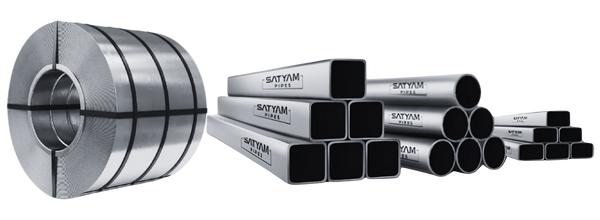
As a leading MS billet and HR coil manufacturer in India, Satyam Steel produces premium ERW pipes engineered for infrastructure needs. We use advanced welding and precision manufacturing to deliver pipes with uniform wall thickness and strong weld joints. Our products comply with Indian standards (IS 1239) and undergo rigorous quality testing. With robust supply chains and nationwide logistics, we offer timely delivery of bulk orders to any project site.
FAQs
Q. What types of steel pipes are used in infrastructure projects?
Major infrastructure projects typically use welded steel pipes (ERW) and seamless steel tubes. ERW pipes (round, square, rectangular) are widely preferred for construction scaffolding and structural frames due to their strength and precise tolerances.
Q. How do I choose the right steel pipe for a highway or bridge project?
Consider load requirements and standards. For highways and bridges, thick-walled, ISI-marked ERW pipes are common. These pipes offer high tensile strength and uniform dimensions. Consult engineers on the required grade and wall thickness based on project design.
Q. Are Satyam Steel's pipes compliant with Indian infrastructure standards?
Yes. Satyam Steel's ERW pipes meet Indian standards (IS 1239) and comply with BIS certification. We maintain ISO 9001 certifications and provide quality test certificates with each order for full traceability.
Request a Quote for Infrastructure Projects
Contact Satyam Steel to discuss your infrastructure project pipe requirements and get a competitive quote for ERW round, square, and rectangular pipes.