India's 2026 Infrastructure Spending Spurs ERW Pipe Demand
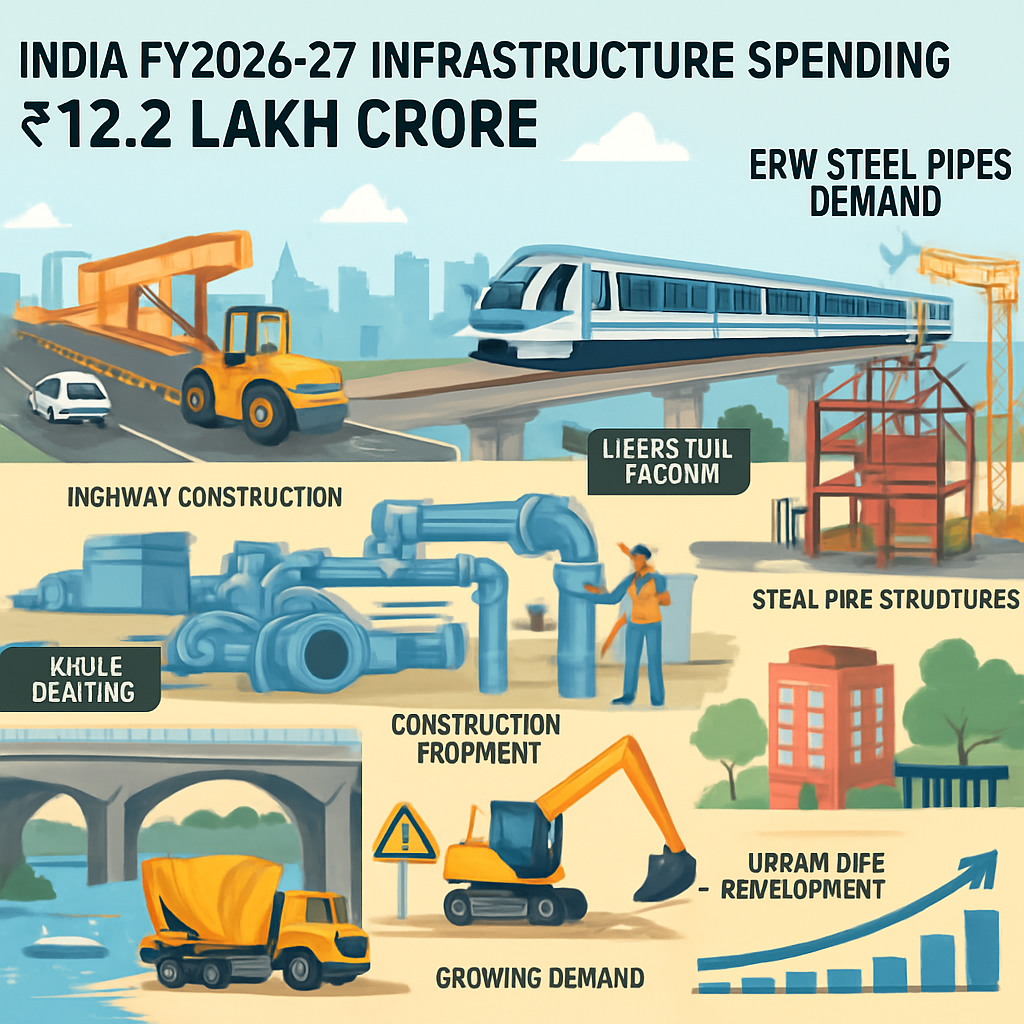
Government capex of ₹12.2 lakh crore fuels record ERW pipe orders across highways, metros, and water networks
Executive Summary: India's Pipe Boom
India's infrastructure investment is surging to record levels, with the 2026–27 budget boosting capex to ₹12.2 lakh crore. This sustained spending on highways, rail corridors, urban water networks, and energy projects is sending demand for steel to new highs. Finished steel output reached 146.8 Mt by February 2026, with domestic demand growing 9–10%. Electric-resistance-welded (ERW) steel pipes, used in fluid transport and structural frames, are among the fastest-growing segments. Analysts report strong ERW orders from metros, airports, highways, and water schemes, with volume growth expected at 10–15% annually.
India's FY2026–27 Budget: Infrastructure-Led Growth Strategy
Public capital expenditure has reached ₹12.2 lakh crore (versus ₹8.4 lakh crore in FY22), reflecting a multi-year commitment to infrastructure development. The budget funds seven new high-speed rail corridors (Delhi–Varanasi, Mumbai–Pune, Hyderabad–Bengaluru) and allocates ₹3.09 lakh crore to the Roads Ministry, with ₹1.87 lakh crore to NHAI (National Highways Authority). In FY2026, NHAI completed 5,313 km of highways—15% above target. Major projects like the Dakuni–Surat freight corridor and the new East Coast Industrial Corridor (with a node at Durgapur) were announced. These large-scale projects entail massive steel use for bridges and supports, plus millions of metres of piping for utilities.
Government Water & Sanitation: A Major Driver
Government water and sanitation schemes further underpin pipe usage. India's Jal Jeevan Mission and Har Ghar Nal Yojana investments ensure steady demand from the WSS (water supply and sewage) and irrigation sectors. The Budget's focus on urban water and sewage (through City Economic Regions and smart city funds) guarantees steady orders for water mains and sewage lines. Every major infrastructure category—roads, rail, cities, energy, and water—is contributing to the pipe market's expansion.
ERW Steel Pipes: Versatility & Market Dominance
Electric Resistance Welded (ERW) steel pipes account for approximately 70% of India's steel pipe volume and are favoured for strength, consistent quality, and cost-effectiveness. Once used mainly for water and fuel lines, ERW pipes are now widely adopted in construction and infrastructure: railways, airports, metro viaducts, high-rise frameworks, and warehouses. A global market report notes that construction applications consume 40% of ERW output worldwide, and ERW capacity in Asia Pacific grew 32% from 2022–24 due to urban development and energy projects.
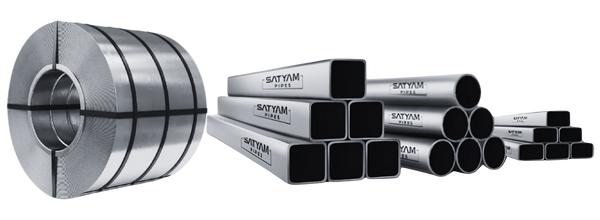
ERW round, square, and rectangular pipes are found across projects as building columns, scaffolds, metro structure supports, highway light poles, and high-pressure process lines. Our product range includes:
- ERW round pipes for structural supports and water distribution
- ERW square pipes for fabrication and construction frameworks
- ERW rectangular pipes for modular and prefab applications
Sector-Wise Use-Cases for ERW Pipes
| Sector | Applications | Example Projects |
|---|---|---|
| Roads & Highways | Guardrails, signposts, lighting poles, toll booths, flyover girders | National Highways (5,313+ km), expressways, Bharatmala bridges |
| Rail & Transit | Metro viaduct supports, overhead bridge structures, handrails | Delhi, Mumbai, Chennai metro lines; Mumbai–Ahmedabad high-speed rail |
| Urban Water & Sewage | Water mains, sewage pipelines, pumping station infrastructure | Jal Jeevan & AMRUT networks, city sewage treatment plants |
| Energy & Utilities | Power plant pipelines, oil & gas lines, transmission structures | Refineries, renewable energy systems, solar farm structures |
| Construction & Real Estate | Structural columns, scaffolding, door frames, fencing | Commercial high-rises, industrial sheds, apartments |
Geographical Hotspots: Pan-India Growth
Demand is nationwide, but key regions show accelerated growth. In West Bengal, the East Coast Corridor (Surat–Dakuni) will spur major projects around Durgapur and Asansol, India's foremost steel and industrial hub. Satyam Steel's Durgapur–Asansol plant is perfectly positioned to serve these regions and nearby projects in Kolkata's metro extensions and power plants.
North India sees Delhi–Varanasi and Delhi–Mumbai corridor planning, boosting demand across Uttar Pradesh and Madhya Pradesh. NHAI's success (5,313 km in FY26) means more contracts in Rajasthan, Gujarat, and Maharashtra. Southern India experiences metro expansions in Bengaluru, Hyderabad, and Chennai—driving local ERW orders. Western India is active with the Pune–Mumbai corridor and renewable projects (wind/solar farms in Maharashtra and Gujarat).
Implications for Buyers & EPCs
Quality and Compliance: With rising demand, ensure suppliers meet BIS/ASTM standards. Public-funded projects require strict compliance.
Diversify Formats: Consider square and rectangular ERW tubes alongside round pipes for structural tasks. Coated ERW products are ideal for corrosive applications.
Local Supply Advantage: India's supply base is expanding. Regions like Bengal have major pipe mills—an advantage for eastern projects. For critical timelines, negotiate priority supply contracts with established manufacturers like Satyam Steel.
Market Outlook & Analyst Forecasts
Industry analysts expect ERW pipe volumes to grow 10–15% in 2026 and beyond. Steel output is expected to reach around 153 Mt in FY26 with supportive policies from the RBI and IBEF. For buyers, this means abundant steel and pipe supply, though competition for high-quality, value-added products will intensify. Staying informed on project pipelines—NHAI tenders, metro budgets, Jal Jeevan contracts—helps EPCs align procurement strategically.
Leveraging Satyam Steel's comprehensive product range—from HR coils to ERW pipes—and regional warehousing ensures timely, cost-effective supply for your infrastructure projects.
FAQs
Q1. Why is ERW pipe demand rising in India for 2026?
India's infrastructure projects (highways, metros, water networks) are expanding rapidly with ₹12.2 lakh crore capex. ERW steel pipes are mission-critical for these projects. CRISIL analysis confirms double-digit growth in ERW consumption driven by roads, rail, and urban development.
Q2. What infrastructure projects use the most steel pipes?
Major users include highways (bridges, sign structures), metros and rail (viaduct supports), and urban water/sewer systems (distribution mains). India's smart city and metro initiatives alone consumed over 9 million metres of ERW pipe. Energy projects (power plants, renewables) also use large-diameter pipelines.
Q3. How should buyers prepare for increased pipe demand?
Secure reliable suppliers with sufficient capacity (look for IS/BIS certification). Diversify pipe types (round, square, rectangular ERW). Plan orders well ahead. Monitor project schedules and raw steel prices. Negotiate longer-term contracts or standing purchase agreements to avoid spot market tightness.
Q4. Which regions in India see fastest growth in pipe demand?
Demand is nationwide, but hotspots include Eastern India (Durgapur–Asansol, East Coast Corridor), Western metros (Mumbai–Pune, Delhi NCR), and Southern cities (Chennai–Bengaluru). Even Tier-II cities now have dedicated infrastructure funding, creating broad-based demand.
Meet Your Infrastructure Pipe Requirements with Satyam Steel
Contact us to discuss your pipeline requirements and secure high-quality ERW pipes for your infrastructure projects across India.