ERW vs Patra Pipes: Which Is Better?
A comprehensive comparison to help you make the right choice for your project
Introduction
When it comes to sourcing steel pipes for construction, infrastructure, or fabrication, buyers frequently encounter two main options: ERW (Electric Resistance Welded) pipes and patra pipes. While both are tubular steel products made from HR coils or steel sheets, they differ significantly in manufacturing precision, quality certification, dimensional accuracy, and end-use suitability.
This guide offers a head-to-head comparison of ERW pipes vs patra pipes across every parameter that matters to buyers, engineers, contractors, and procurement professionals. By the end, you will have a clear understanding of which pipe type best suits your specific requirements.
Understanding ERW Pipes
ERW pipes are manufactured using Electric Resistance Welding technology, where steel strips are continuously formed into a tubular shape and the edges are welded together using high-frequency electric current without any filler material. This process creates a strong, clean weld seam with excellent structural integrity.
Key Characteristics of ERW Pipes
- Precision manufacturing with tight dimensional tolerances
- BIS certification (IS 1239, IS 4923, IS 3589) and ASTM compliance
- NDT tested (ultrasonic/eddy current) weld seams for reliability
- Smooth, uniform surface finish with scarfed weld bead
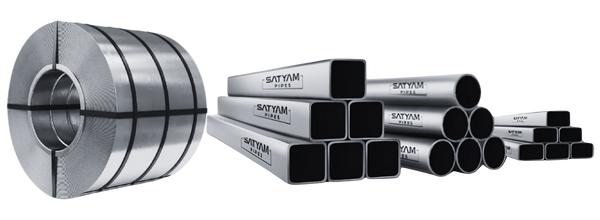
- Available in round, square, and rectangular cross-sections
- Available in galvanized (GI) and black finishes
- Consistent wall thickness throughout the pipe length
Understanding Patra Pipes
Patra pipes are mild steel (MS) pipes produced from steel sheets or HR coils using conventional roll forming and welding methods. These pipes are manufactured with commercial-grade tolerances and are designed primarily for applications where affordability and basic structural strength take priority over precision.
Key Characteristics of Patra Pipes
- Commercial-grade manufacturing with moderate tolerances
- No BIS certification in most cases
- Visual inspection only for quality control
- Rougher surface finish compared to ERW pipes
- Available mainly in round and square sections
- Typically available in black (uncoated) finish only
- Wall thickness may vary slightly along the length
Head-to-Head Comparison: ERW vs Patra Pipes
| Parameter | ERW Pipes | Patra Pipes | Verdict |
|---|---|---|---|
| Manufacturing Method | Electric Resistance Welding | Conventional forming & welding | ERW wins |
| Dimensional Accuracy | High (tight tolerances) | Moderate (commercial tolerance) | ERW wins |
| Quality Certification | BIS / IS / ASTM certified | Commercial grade (no BIS) | ERW wins |
| Weld Seam Quality | NDT tested, scarfed, uniform | Visual inspection only | ERW wins |
| Surface Finish | Smooth and uniform | Rough, basic finish | ERW wins |
| Wall Thickness | Uniform throughout | May vary along length | ERW wins |
| Cost | Higher (premium quality) | 10-25% lower | Patra wins |
| Availability | Through certified dealers | Widely available locally | Patra wins |
| Corrosion Protection | GI and black options | Black (uncoated) only | ERW wins |
| Service Life | Longer due to quality | Shorter, adequate for use | ERW wins |
| Strength-to-Weight Ratio | Optimized | Adequate | ERW wins |
Applications Where ERW Pipes Are Better
ERW pipes are the clear winner in applications that demand precision, safety, and certified quality:
- Water supply and distribution systems in municipal and residential projects
- Plumbing and sanitary installations in buildings and commercial complexes
- Gas pipelines where leak-proof joints and pressure resistance are critical
- Structural columns and beams in multi-story buildings and bridges
- Fire-fighting systems requiring BIS-certified pipes
- Government and institutional projects with mandatory IS standard compliance
- Automotive and machinery components requiring tight tolerances
- Oil and gas industry for transmission and distribution lines
Applications Where Patra Pipes Are Better
Patra pipes offer practical value in cost-sensitive and non-critical applications:
- Scaffolding and temporary supports at construction sites
- Boundary fencing for agricultural and industrial land
- Furniture manufacturing including beds, tables, chairs, and racks
- Greenhouse structures and agricultural supports
- Workshop fabrication for frames, sheds, and storage solutions
- General-purpose structural applications where BIS is not required
- Low-rise construction support structures and handrails
Cost Analysis: Total Value Perspective
While patra pipes offer an immediate cost advantage of 10% to 25%, smart procurement decisions should consider the total cost of ownership:
| Cost Factor | ERW Pipes | Patra Pipes |
|---|---|---|
| Initial Purchase Price | Higher | Lower |
| Maintenance Cost | Lower (longer life) | Higher (earlier replacement) |
| Compliance Cost | Included (BIS certified) | Risk of project rejection |
| Wastage | Minimal (precise sizing) | Higher (variable dimensions) |
| Installation Efficiency | Faster (consistent fit) | May need adjustments |
For projects with a lifespan of 10+ years, ERW pipes typically deliver better total value despite the higher upfront cost. For short-term or temporary applications, patra pipes remain the economical choice.
How to Identify ERW Pipes vs Patra Pipes
Buyers should be able to visually and physically distinguish between the two pipe types:
- Surface markings: ERW pipes carry ISI/BIS markings, manufacturer name, grade, and size. Patra pipes may only have basic identification.
- Weld seam: ERW pipes have a clean, scarfed weld that is barely visible. Patra pipe welds may be more prominent.
- Surface texture: ERW pipes feel smoother and more uniform. Patra pipes may show surface irregularities.
- Weight consistency: ERW pipes have consistent weight per meter due to uniform wall thickness. Patra pipes may vary.
- Mill test certificate: ERW pipe manufacturers provide detailed test certificates. Patra pipes may come with basic documentation only.
Quality Standards: Why They Matter
One of the most critical differences between ERW and patra pipes is quality certification. ERW pipes manufactured by companies like Satyam Steel comply with:
- IS 1239: For mild steel tubes, tubulars, and other wrought steel fittings
- IS 4923: For hollow steel sections for structural use
- IS 3589: For steel pipes for water and sewage
- ASTM A500: For cold-formed welded carbon steel structural tubing
These standards ensure the pipe meets minimum mechanical properties, chemical composition, dimensional tolerances, and testing requirements. Government projects, institutional construction, and critical infrastructure almost always mandate IS-certified pipes, making ERW the only compliant option.
Satyam Steel: Your Partner for Both ERW and Patra Pipes
As a leading integrated steel manufacturer, Satyam Iron & Steel Company produces both high-quality ERW steel pipes and patra pipes from its manufacturing facilities in West Bengal. Here is what sets us apart:
- In-house raw material production: HR coils, sponge iron, and billets are manufactured in-house, ensuring quality from the source.
- BIS-certified ERW pipes: Available in round, square, and rectangular sections with full testing and certification.
- Cost-effective patra pipes: For structural and fabrication needs, manufactured with consistent quality.
- Pan-India supply network: Efficient logistics from our facilities across multiple locations in West Bengal.
- Technical support: Our team helps buyers select the right pipe type based on project requirements.
The Verdict: Which Is Better?
There is no one-size-fits-all answer. The better choice depends entirely on your project requirements:
Choose ERW pipes if: You need precision, BIS certification, long service life, pressure resistance, or compliance with government standards. ERW pipes are the professional-grade choice for serious construction, infrastructure, and industrial applications.
Choose patra pipes if: You need an affordable solution for temporary structures, general fabrication, furniture, fencing, or any non-critical application where commercial-grade quality is sufficient and budget is the primary driver.
In terms of overall quality, reliability, and long-term value, ERW pipes are the superior product. But patra pipes have their rightful place in the market for cost-effective, utility-focused applications. The key is matching the right pipe type to the right application.
Conclusion
Both ERW pipes and patra pipes serve important roles in the Indian steel market. Understanding their differences in manufacturing, quality, cost, and application is essential for making smart procurement decisions. Whether you are a contractor building high-rise structures or a fabricator assembling workshop equipment, choosing the right pipe type ensures your project succeeds in terms of both performance and budget.
Partnering with a trusted manufacturer like Satyam Iron & Steel Company that produces both ERW and patra pipes gives you access to consistent quality, competitive pricing, and expert guidance across the full range of steel pipe products.
FAQs
Q1. Which is better, ERW pipe or patra pipe?
ERW pipes are better for applications requiring high precision, BIS certification, and long-term durability such as plumbing, gas lines, and structural engineering. Patra pipes are better for cost-sensitive applications like scaffolding, fencing, and general fabrication where commercial-grade quality is acceptable.
Q2. What is the cost difference between ERW pipes and patra pipes?
Patra pipes are typically 10% to 25% cheaper than ERW pipes of similar dimensions. However, the price difference depends on market conditions, specifications, and order volume. ERW pipes offer better value in the long run due to superior quality and longer service life.
Q3. Can patra pipes replace ERW pipes in construction?
Patra pipes can be used in non-critical construction applications such as scaffolding, temporary structures, and boundary fencing. However, for load-bearing structures, water supply, fire-fighting systems, and government-certified projects, ERW pipes are mandatory due to their compliance with IS standards.
Q4. How do I identify the difference between ERW pipe and patra pipe?
ERW pipes have a smooth, uniform surface finish with consistent wall thickness, visible ISI markings, and a clean weld seam. Patra pipes typically have a rougher surface, may show slight variations in wall thickness, and usually lack BIS certification markings.
Q5. Does Satyam Steel manufacture both ERW and patra pipes?
Yes, Satyam Iron & Steel Company manufactures a wide range of ERW steel pipes including round, square, and rectangular sections, as well as patra pipes for structural and fabrication applications, ensuring quality across all product lines.
Need ERW Pipes or Patra Pipes?
Contact Satyam Steel for premium quality ERW steel pipes and cost-effective patra pipes. Our team will help you choose the right product for your project requirements.