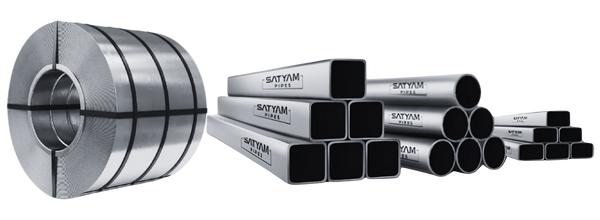
ERW Pipes vs Hollow Sections: Which is Better for Structural Projects?
A detailed technical and economic comparison
Introduction: ERW Pipes and Hollow Sections Defined
In structural engineering, two primary tubular steel products dominate: ERW (Electric Resistance Welded) pipes and hollow structural sections (HSS). While both are hollow tube products, they differ in manufacturing process, dimensional tolerances, strength properties, cost, and optimal applications. Understanding these differences helps engineers and procurement professionals select the right material for specific projects.
Manufacturing Process
ERW Pipes (Electric Resistance Welding)
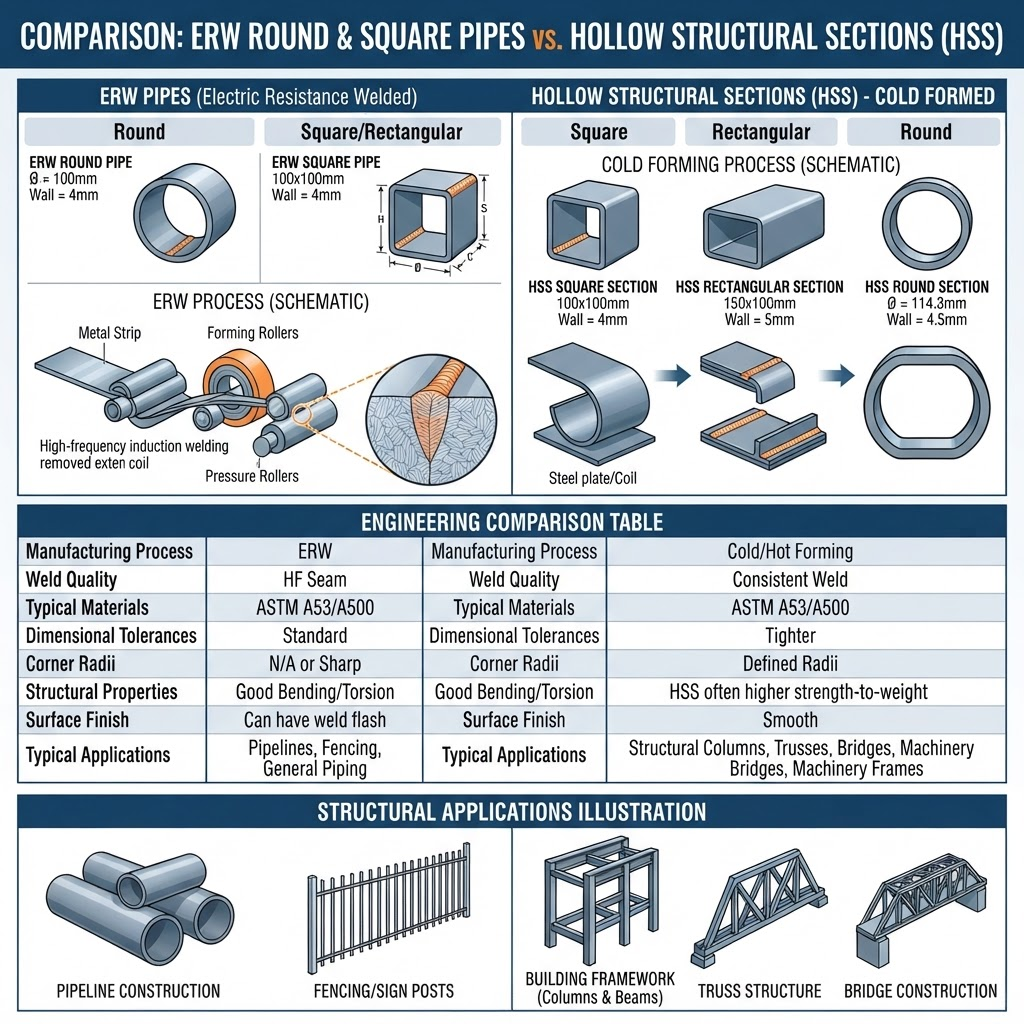
ERW pipes are manufactured by coiling flat steel strip and passing it through an electric resistance weld to fuse the edges. The process is fast, scalable, and produces consistent quality. ERW round pipes, square pipes, and rectangular pipes are all available. Satyam Steel produces ERW pipes with tight dimensional tolerances and consistent weld quality.
Hollow Structural Sections (HSS)
HSS are typically cold-formed from ERW pipe or can be produced using other methods. They are usually smaller diameter (up to 200 mm) and lighter-walled. HSS are popular in architectural and light fabrication applications due to their aesthetic appeal and ease of jointing.
Key Comparison Factors
| Aspect | ERW Pipes | Hollow Sections (HSS) |
|---|---|---|
| Diameter Range | 20 mm to 600+ mm | Typically 50–200 mm |
| Wall Thickness | 1.0 mm to 12+ mm | Typically 2–6 mm |
| Strength (MPa) | 250–550 (depends on grade) | 250–450 |
| Tolerances | Tight tolerances ±1–2% | Standard tolerances ±3–5% |
| Cost (per MT) | ₹35,000–45,000 | ₹40,000–50,000 |
| Applications | Heavy infrastructure, water lines, utilities | Light commercial, architectural, railing |
Strength and Load-Bearing Capacity
ERW pipes are engineered for heavy loads. Their ability to accommodate larger diameters and thicker walls makes them ideal for structural supports in bridges, highways, and industrial facilities. Hollow sections, with their lighter construction, are better suited for low-to-moderate loads in architectural and facade applications. For critical infrastructure, ERW pipes are the preferred choice due to their superior strength-to-weight ratio and load-bearing capability.
Cost Considerations
ERW pipes offer excellent value for large-diameter applications. Hollow sections are more cost-effective for smaller-diameter, lighter-walled applications. When comparing prices, consider: material cost per metre, wall thickness available, tolerance precision, and whether custom sizes are needed. For bulk orders, Satyam Steel offers competitive pricing and volume discounts on both ERW pipes and customized hollow sections.
Which Should You Choose?
Choose ERW Pipes if:
• Project involves heavy structural loads (bridges, buildings, utilities)
• Large diameter and thick wall requirements
• Tight tolerances and consistency are critical
• Water or fluid transport is involved
Choose Hollow Sections if:
• Application is architectural or aesthetic
• Light-to-moderate loads only
• Standard sizes and tolerances suffice
• Cost optimization is the priority
Satyam Steel's Offerings
Satyam Steel manufactures a comprehensive range of ERW pipes (round, square, rectangular) with diameters up to 600 mm and wall thicknesses from 1.0 mm to 12.5 mm. We also provide custom hollow sections and can tailor products to meet specific project requirements. Our ISO 9001 certification and BIS licenses ensure compliance with Indian and international standards.
FAQs
Q. Can hollow sections be used instead of ERW pipes for heavy loads?
Generally no. Hollow sections are designed for light-to-moderate loads. For heavy structural applications, ERW pipes offer superior load-bearing capacity due to their larger diameters and thicker walls.
Q. What is the typical cost difference?
ERW pipes are often cheaper per tonne for bulk infrastructure projects. Hollow sections are cost-effective for small-diameter, light-wall applications. Price depends on size, wall thickness, and order volume.
Q. Can ERW pipes be used for architectural applications?
Yes, but they're less common for pure aesthetic use. Hollow sections are preferred for architectural railings and facades due to their lighter weight and sleeker profile.
Get Technical Support for Your Project
Contact Satyam Steel's engineering team to discuss which product—ERW pipes or hollow sections—is best for your structural project.