How India's Manufacturing Boom is Increasing Demand for High-Quality Steel Pipes
PLI schemes, Make in India, and industrial expansion driving unprecedented pipe consumption
India's Manufacturing Renaissance
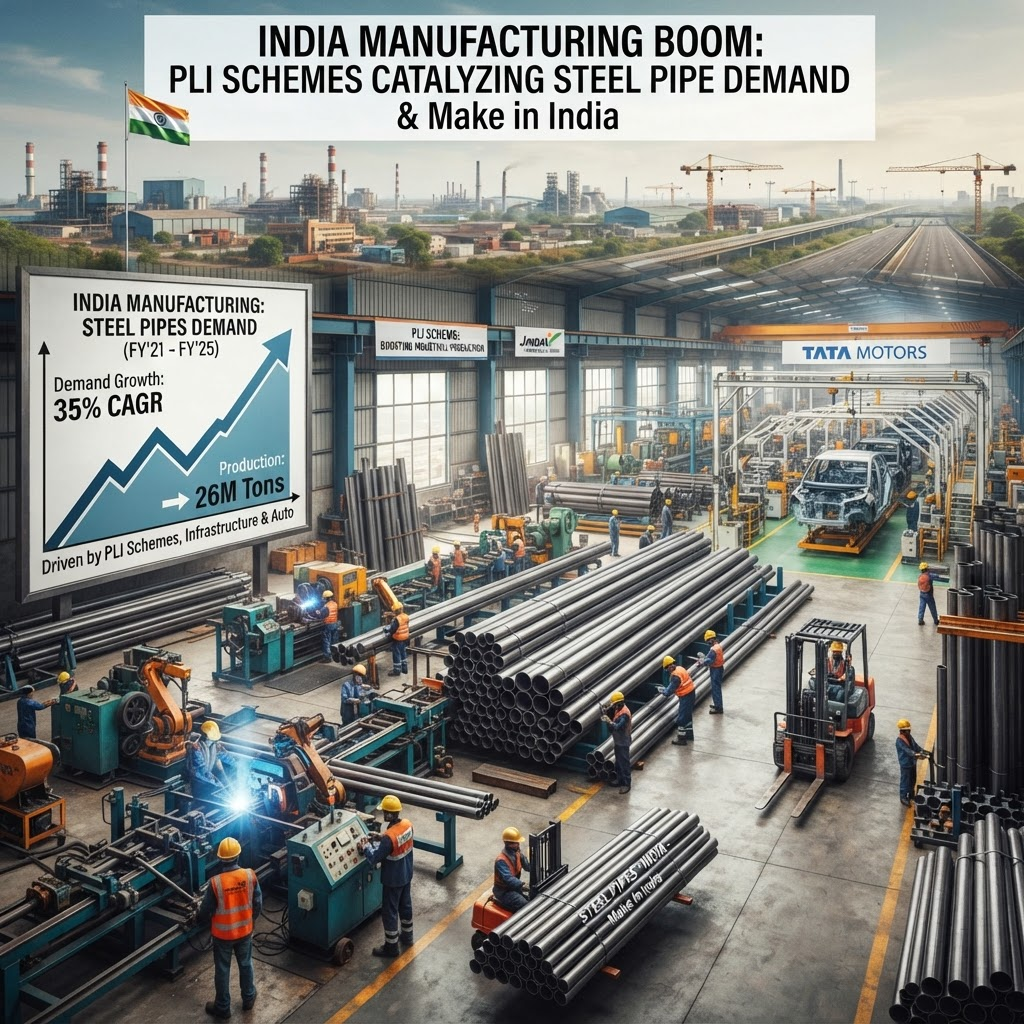
India's manufacturing sector is experiencing unprecedented growth, driven by government policies like Make in India, Production-Linked Incentive (PLI) schemes, and rising demand from global supply chain diversification. This manufacturing boom is translating directly into surging demand for quality steel pipes and structural components. Manufacturers across automotive, electronics, appliances, and heavy engineering sectors are expanding capacity and investing in new facilities—all consuming large volumes of steel pipes for construction, equipment frames, and hydraulic systems.
Key Drivers of Manufacturing Growth
1. Production-Linked Incentive (PLI) Schemes
The PLI scheme incentivizes domestic manufacturing in sectors like automotive, electronics, pharmaceuticals, and textiles. Companies receiving PLI benefits are aggressively expanding factory footprints, adding production lines, and investing in plant and machinery. This expansion creates direct demand for structural steel pipes, equipment supports, and hydraulic components.
2. Make in India and Localization Push
Government policies encourage companies to increase local content and shift manufacturing from China to India. This policy shift is attracting multinational manufacturers to establish or expand operations in India, creating factories and industrial zones that require extensive steel infrastructure.
3. Global Supply Chain Diversification
Post-pandemic, multinational corporations are diversifying their supply chains away from over-concentration in Asia, particularly China. India, with its large workforce, stable business environment, and government incentives, is becoming a preferred manufacturing destination. New factories and expansion of existing facilities are underway across automotive, electronics, and heavy equipment sectors.
Sectors Driving Steel Pipe Demand
Automotive Sector
India produced over 25 million vehicles in FY2025, and output is expected to grow further. Vehicle manufacturing facilities require extensive steel pipes for chassis frames, exhaust systems, hydraulic lines, and equipment supports. Frame manufacturing alone uses significant quantities of ERW rectangular and square pipes.
Electronics and Appliance Manufacturing
Electronics PLI schemes are attracting smartphone, semiconductor, and appliance manufacturers to India. Factory construction and equipment installation consume large volumes of structural steel pipes. Supporting frame structures for conveyor systems, production lines, and material handling use ERW pipes extensively.
Heavy Equipment and Machinery
Manufacturers of tractors, construction equipment, and industrial machinery are expanding to meet domestic and export demand. These sectors rely heavily on steel pipes for structural frames, hydraulic systems, and support structures. MS hot-rolled coils and billets are raw materials for these pipes.
Steel Pipe Applications in Modern Factories
Modern manufacturing facilities use steel pipes for:
- Structural supports and columns (ERW square/rectangular pipes)
- Material handling and conveyor systems (welded and seamless pipes)
- Hydraulic and pneumatic lines (high-pressure pipes)
- Equipment frames and machine bases (structural sections)
- Cable trays and raceways (structural tubes)
- Scaffolding for temporary construction (black ERW pipes)
Supply Challenges and Opportunities
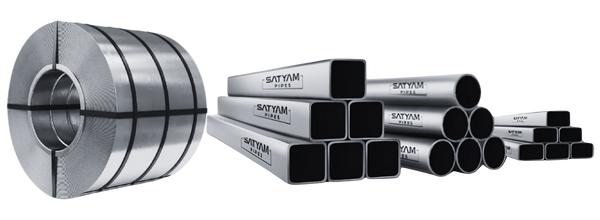
The rapid manufacturing expansion has created a supply-demand mismatch. Procurement managers report tight schedules and long lead times from certain suppliers. Integrated steel manufacturers like Satyam Steel—with in-house HR coil and billet production—are well-positioned to meet surging demand reliably. Working directly with large-capacity manufacturers ensures priority allocation, flexible delivery schedules, and competitive pricing.
Long-Term Outlook: Sustained Growth
The manufacturing boom is expected to sustain through 2026 and beyond. PLI incentives run through 2024–29, providing multi-year certainty for factory expansion projects. This sustained growth provides confidence for steel manufacturers and suppliers to invest in capacity expansion, knowing demand will remain robust. For buyers, this presents opportunities for long-term contracts and stable pricing from reliable suppliers.
FAQs
Q. Which manufacturing sectors are growing fastest in India?
Automotive (especially electric vehicles), electronics and semiconductors, pharmaceuticals, and heavy equipment are experiencing rapid PLI-driven growth.
Q. How long will the manufacturing boom last?
PLI schemes run through 2028–29, providing at least 3–4 years of continued growth drivers. Supply chain diversification trends suggest sustained expansion beyond PLI expiry.
Q. How can I secure reliable steel pipe supply for my factory expansion?
Engage directly with large integrated manufacturers. Long-term contracts and volume commitments ensure priority allocation and competitive pricing during tight supply periods.
Get Industrial Solutions for Your Manufacturing Plant
Contact Satyam Steel to discuss steel pipe requirements for your factory expansion, production lines, and equipment supports. We offer bulk supply and flexible terms for manufacturing operations.