Steel Pipe Quality Checklist for EPC, Construction & Industrial Buyers in India
A practical inspection guide before accepting any pipe delivery
Why a Quality Checklist Matters
Before finalizing any steel pipe purchase, buyers must verify a number of quality criteria to avoid costly project delays and rework. Whether you are an EPC contractor, fabricator, or industrial buyer, a structured inspection process at the time of delivery protects your project and your budget. This checklist covers every major checkpoint, from material grade to final documentation.
1. Material & Grade Verification
Confirm the steel grade meets your project requirements (e.g. IS 1239 medium grade, ASTM A53 Gr B, etc.) and that the manufacturer is BIS licensed for it. Request and review the Mill Test Certificate (MTC) for chemistry (carbon, manganese, etc.), mechanical properties (yield, UTS), and heat-number traceability. For safety-critical use, ensure the MTC is issued to type 3.1/3.2 standards.
2. Dimension & Tolerance Checks
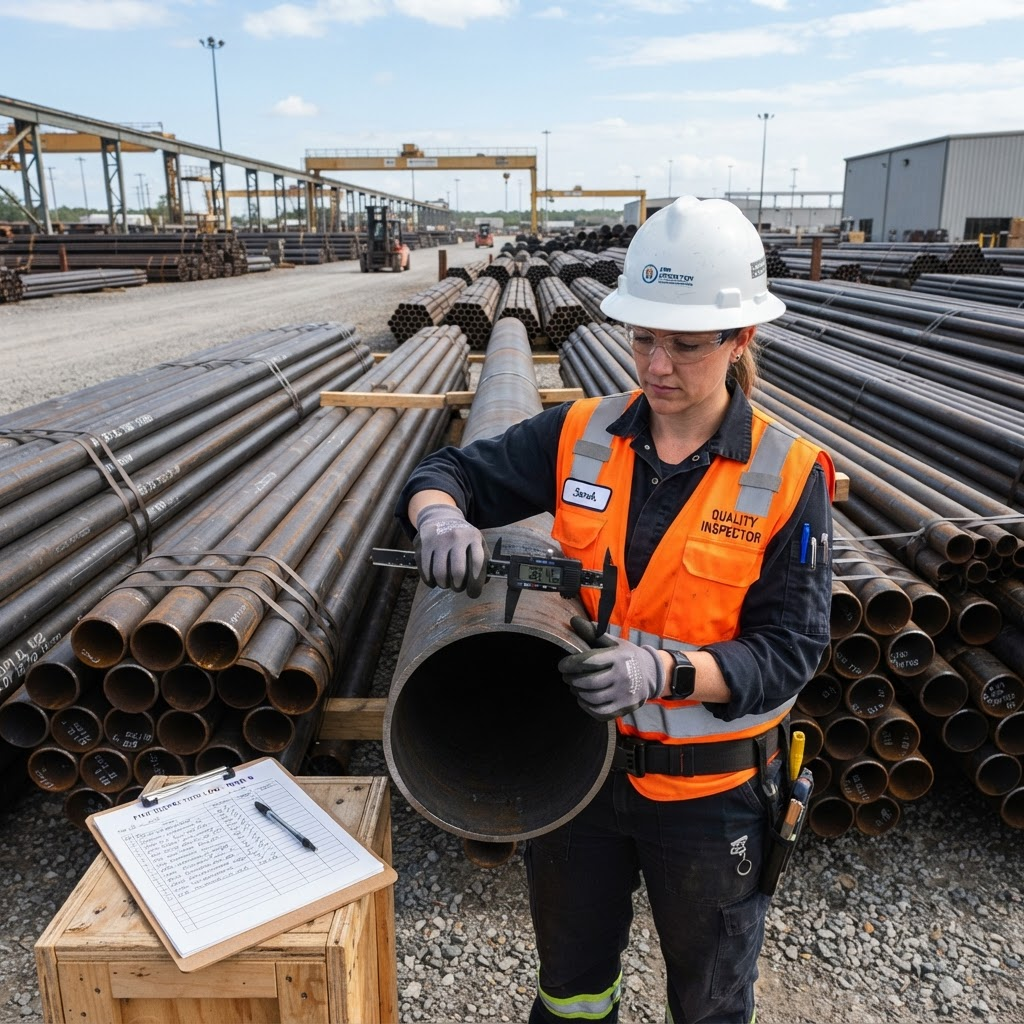
Use gauges or calipers to measure several samples for outer diameter, wall thickness, and length. Compare the readings against your order specification — mill drawings typically allow around ±12.5% on thickness and ±50 mm on nominal lengths. Always confirm the actual OD matches the ordered size, as nominal versus actual sizing can cause confusion. Straightness should stay within the allowed bow tolerance for the length ordered.
3. Weld & Structural Integrity
Inspect the weld seam on every ERW pipe: it should be continuous, properly fused, and free of cracks. For structural applications, consider having random samples X-rayed (RT) or ultrasonically tested (UT) for weld flaws. For pressure applications, verify that the required hydro-test was completed and passed, and check surfaces for lamination defects. Our ERW round pipes, square pipes, and rectangular pipes are all produced with continuous automated weld monitoring.
4. Surface & Coating Inspection
Check that pipes carry the correct surface treatment — black paint, galvanizing, or epoxy coating — as ordered. For GI pipes, verify zinc coating thickness (typically 80–120 g/m²). Coated or painted surfaces should be uniform and undamaged, and free of rust pits, deep dents, or foreign weld spatter.
5. Ends & Fittings
Verify the end finish matches the order: plain, bevelled, or threaded-and-coupled. Pipe ends should be square-cut or correctly bevelled for welding, and any threaded couplings must have fully engaged threads with intact seals.
6. Third-Party Inspection (TPI)
For major infrastructure or power/petroleum projects, insist on TPI or IBR certification. If an IBR Form III-C is required, ensure the factory arranges accredited inspection and stamping, and that these certificates accompany the shipment.
7. Documentation & Labelling
Each bundle should be labeled with grade, size, length, and mill batch/heat number. The packing list must include all materials shipped, and invoice details should match the delivery (length and weight). Keep all documentation — MTC, inspection reports, and e-way bill — for project records.
Common Red Flags to Watch For
An extremely low price, a missing MTC at dispatch, no mention of GST, or a supplier unwilling to disclose the mill name are all major warning signs. Always resolve such issues before accepting goods on site. For guidance on choosing a reliable, ISI-certified supplier in the first place, read our guide on selecting an ISI-certified steel pipe manufacturer.
Why Satyam Steel
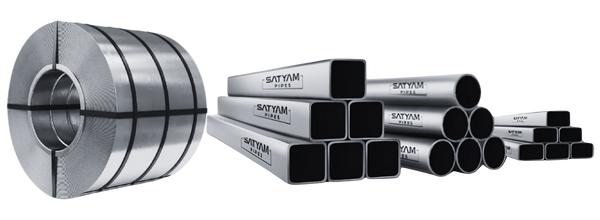
Satyam Steel manufactures ERW round, square, and rectangular pipes as well as HR coil and MS billets from our integrated West Bengal facilities (Durgapur, Asansol, Raniganj). Every batch is supported with full Mill Test Certificates, and we can arrange third-party inspection for critical infrastructure and industrial orders on request.
FAQs
Q. What are the first things to check when a steel pipe delivery arrives?
Start with the paperwork: ensure you have the Mill Test Certificate, invoice, and inspection report on hand. Then measure a few pipes for correct OD, wall thickness, and length, and check that steel grades and markings match your order specifications.
Q. How important is the BIS/ISI mark on pipe bundles?
The ISI mark is mandatory for mild steel pipes under IS 1239. Every bundle should display the ISI logo and license number — this is your assurance that the pipes meet Indian Standards. If it is missing, contact the supplier immediately.
Q. Who pays for defects found after delivery?
A reliable manufacturer will rectify or replace pipes found out of spec if reported within the agreed inspection window. Always clarify this timeline and process in your purchase contract.
Get a Compliant, Fully-Certified Steel Pipe Order
Satyam Steel supplies ERW, GI, and structural pipes with full Mill Test Certificates and inspection support for EPC and industrial projects across India.